By Kayla Sauderman

The Crime of the Century
Few would dispute that the American legal system is capable of profound injustice. The 19th century demonstrated this well, denying the Declaration’s unalienable rights to an entire class of people and dehumanizing both in law and in rhetoric some image bearers of God.
It’s in this context that abortion abolitionists point out that American jurisprudence has never sought to protect all humans, specifically prenatal humans, equally under homicide law. Unfortunately, the Pro-Life Movement has maintained this historical oversight for over half a century despite claiming these children deserve life.
While much of pro-life practice is functionally Marxist, the lack of legal protection for prenatal children didn’t originally come from Marxist theory. It developed into that sometime later. Originally, it came from a struggling new legal attempt to codify unwritten English Common Law into statutory law, and abortion was just one of many issues that was facing judicial reform.
When the 1821 Connecticut legislature passed its first statute addressing abortion, it did not do so out of protection for the prenatal child but as a targeted response to a specific act of violence involving the case of Ammi Rogers and Asenath Smith. The legal problem the state confronted was not a developed moral theory of abortion, but the practical difficulty of prosecuting poisoning and concealed violence during pregnancy.
Ammi Rogers, a controversial Episcopal clergyman, engaged in an illicit affair with a young woman named Asenath Smith, leading to an unplanned pregnancy. Fearing the ruin of his reputation, Rogers orchestrated a plan to kill the prenatal child. He initially administered a series of chemical ‘poisons’—about the only way abortion was commonly done during that time period—yet it failed. He then resorted to a physical instrument to kill the baby in utero. The scheme was exposed after Smith contracted a severe infection, ultimately delivering a stillborn infant past the age of ‘quickening’—a critical legal threshold that turned the act into a high crime.
The Connecticut District Attorney who investigated the incident was appalled by Rogers’s actions. Not only did Rogers violently and physically seek to end the child’s life, but he also kidnapped Smith and her sister in an attempt to convince them to remain quiet about the ordeal. In the end, Smith’s sister squealed and the District Attorney decided to bring Rogers to trial.
The details of the case were apparently so gruesome that the official transcript of the trial began with, “It may be said that this is a crime of more than ordinary turpitude; of a most depraved and licentious character; unfit for public perusal, and public animadversion…” (1)
From this peculiar crime came the effort to legally prosecute “predatory men.” But there was a slight hiccup for 19th-century prosecutors. Abortion performed before quickening—around 20 weeks—was rarely seen as criminal under Common Law standards because it was near impossible to prove a crime had occurred in the first place. The Rogers case convinced 19th-century legal experts to pass a law to formally document that “administering poison” to a pregnant woman, regardless of the age of the prenatal child, was a “high crime.” The statute read:
“Every person who shall, wilfully and maliciously, administer to, or cause to be administered to, or taken by any woman, then being quick with child, any deadly poison, or other noxious and destructive substance, with an intention thereby to murder, or thereby to cause or procure the miscarriage of such woman, and shall be thereof duly convicted, shall suffer imprisonment in New-Gate prison, for a term not exceeding seven years, nor less than seven years.” (2)
By 1828, New York passed a more structured abortion law that classified abortion before 20 weeks as a misdemeanor and established manslaughter charges after 20 weeks, with an allowance for abortion at any point if a doctor deemed it was necessary to save a woman’s life.
Despite the Rogers case being admittedly rare and unusual, these early laws focused narrowly on prosecuting men who utilized abortion to mask sexual indiscretions or who physically harmed women in the process. At this stage, no unified ‘victim narrative’ yet existed—only fragmented legal responses to specific acts of violence. Twenty years later, however, abortion law and the prevailing view of the women involved took a decisive turn.
The Physician’s Crusade
The first American abortion laws were seemingly passed in a knee-jerk reaction to a sensationalized scandal. The abortion laws that emerged in the 1840s and onward developed from different motives: There was a social movement under way to professionalize medicine.
The “Physicians’ Crusade,” made up of doctors who would eventually form the American Medical Association, wanted to establish national standards for doctors, eliminate competition, and combat “snake oil” con artists.
They lobbied for laws to push out “irregular” practitioners—including midwives and herbalists—who happened to provide abortion services. One way these doctors thought they could stamp out their competition was by criminalizing some of the main sources of income or specialties of the midwives and alternative practitioners.
This shrewd business move—coupled with English Common Law views on abortion—opened the door to centuries of regulating prenatal murder rather than abolishing it.
At the time, the argument was made that exempting women from abortion regulations was a practical necessity for prosecutors. To convict an “underground” midwife or unlicensed abortionist, the state said it needed the woman’s testimony.
It was argued that if the woman were liable for the crime, she could plead the Fifth Amendment to avoid incriminating herself. If, however, the state granted her immunity, she could be forced to testify against the abortionist or be held in contempt of court. This resulted in the woman being “victimized” on paper. A legal category was created to stick a pregnant woman in so that prosecutors could extract testimony from her in order to go after who they really wanted.
Three things are worth noting. First, the drive to criminalize abortion was focused on punishing licentious men and regulating a blooming medical industry, not from a driving conviction that all abortion was murder.
Despite Christian history asserting that abortion is murder, it was rarely prosecuted as such. The primary obstacle was evidentiary: the inability to determine if a human life had truly been maliciously ended. This necessitated the ‘quickening’ law—a standard based on the woman’s perception of fetal movement and the physical visibility of the child if delivered. In an era where ultrasound technology was non-existent and microscopes were absent from clinical practice, the law relied on what the naked eye could see. In other words: no body, no crime.
Second, immunity jurisprudence is not relevant in the 21st century. While 19th-century prosecutors believed they needed to grant immunity because they lacked the forensic tools to prove a crime without a woman’s testimony, that necessity has completely vanished. Between DNA, search histories, encrypted communications, Ring doorbells, security cameras, and other eyewitness testimony, the ‘science’ now speaks for itself. Abortion stands alone as a unique legal outlier: it is perhaps the only area of law where immunity for a key participant is codified directly into statute, rather than being a discretionary tool used by the state to catch a ‘bigger fish.’ In the 21st century, this statutory shield is no longer a forensic excuse; it’s a jurisprudential fossil.
Third, even with a lack of forensic evidence, blanket legal immunity circumvents God’s precept for justice. When the law was first delivered from God to people through Moses, he began with instructions to not pervert justice, to not allow the innocent to be killed, and to not acquit the guilty (Exodus 23:6-8). Yet immunity law does all three. It perverts justice due to prenatal children by exempting some of their perpetrators from prosecution and by not treating their deaths as homicide but rather as medical malpractice.
This neglect of justice is based on an inversion of Isaiah 55. Instead of God’s ways, thoughts, and standards being superior to ours, American jurisprudence began to assume it had a better way of dealing with wrongdoing. At this point, the legal category of the “victimized woman” began to expand beyond procedural necessity and into ideological interpretation.
A New Use for Victim Propaganda
While the courts framed mothers as victims for procedural leverage and the Physicians’ Crusade weaponized that narrative to crush their professional competitors, it was a third, far more radical faction that matured the ‘second victim’ framework: the suffragists.
These women were more than mere reformers; they were effectively ‘Marxists-lite.’ It was no coincidence that Victoria Woodhull and Tennessee Claflin used their Weekly newspaper to debut the first English translation of Karl Marx’s Communist Manifesto to an American audience. For them, the ‘victimization’ of women via abortion was a byproduct of a capitalist and patriarchal system. They wrote of the Communist Manifesto:
“We reproduce an important document, principally the production of Karl Marx, the world-famous leader of the “New Socialism,” which will be read with great interest at this time, when the progress of the “International Workingmen’s Association” makes the historical evolution so clearly described in this manifesto … The manifesto we reproduce is a valuable document, and if for no other end than its preservation, we are glad to give it room in our pages.” (3)
When Marx died, Woodhull publicly lamented his untimely death, saying he had been instrumental for the cause of female liberation. 👇

Woodhull & Claflin’s Weekly, September 23, 1871, p. 3.
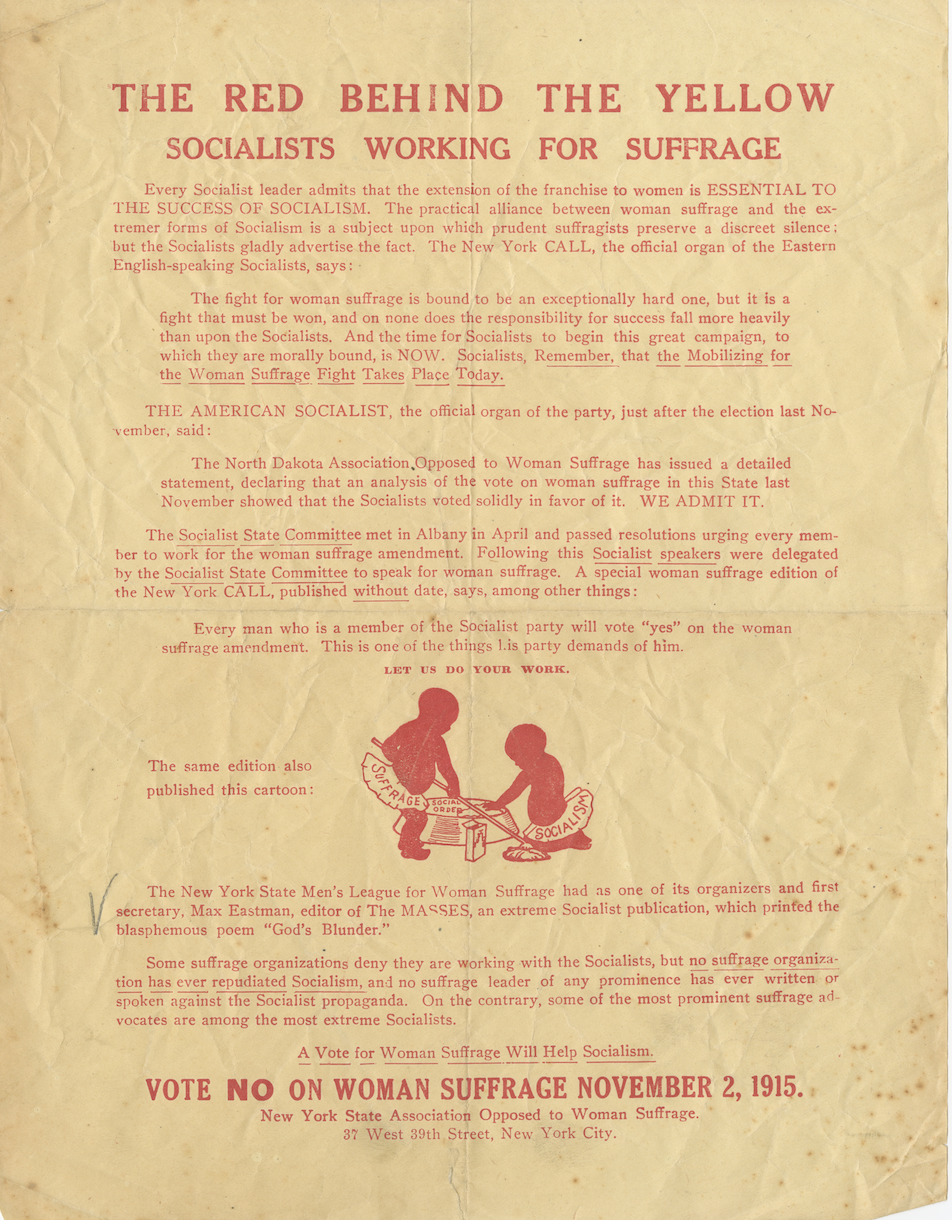
Suffrage support for socialism—and suffrage promotion by socialists—continued into the 20th-century. A 1915 anti-suffrage flyer distributed in New York reminded citizens that “every socialist leader admits that” woman’s suffrage “is essential to the success of socialism.” (4)
Similarly, The American Socialist party bragged to its supporters:
“The North Dakota Association Opposed to Woman Suffrage has issued a detailed statement, declaring that an analysis of the vote on woman suffrage in this State last November showed that the Socialists voted solidly in favor of it. WE ADMIT IT.” (5)
Likewise, a snippet from a 1914 newspaper recorded, “The Progressive [Marxist] party stood with the Socialist party for woman suffrage—definitely and specifically committed to it.” (6)
The reason Marxists and socialists were eager to back the suffrage movement was due to the fact that Marxist outcomes required the dismantling of traditional marriage and the nuclear household—and the suffragists were doing exactly that work in their pursuit of liberating women from unwanted marriages and motherhood. 👇

Friedrich Engels, The Origin of the Family, Private Property and the State, chap. 2, Marxists Internet Archive.

Karl Marx and Friedrich Engels, Manifesto of the Communist Party, chap. 2, “Proletarians and Communists,” Marxists Internet Archive.

August Bebel, Woman and Socialism, chap. 1, “The Position of Woman in Primeval Society,” Marxists Internet Archive.
Using similar socialist-Marxist language, first-wave feminists crafted emotionally charged arguments against the patriarchy. Through speeches, books, essays, newspaper articles and pamphlets, suffragists regularly nagged the public about what they perceived as systemic oppression against women. 👇

Proceedings of the Free Convention: Held at Rutland, Vt., July 25th, 26th, and 27th, 1858, pg. 31.

Mary Krane Derr, Rachel MacNair, and Linda Naranjo-Huebl, eds., Pro-Life Feminism: Yesterday and Today (Amherst, NY: Prometheus Books, 1995), 44.

Matilda Joslyn Gage, Woman, Church and State (Chicago: Charles H. Kerr & Co., 1893), 11.

Lucretia Mott, quoted in Outspoken Women: An Anthology of Women’s Voices in the Nineteenth Century (New York: [publisher not listed], n.d.), 111.
Like economic Marxists, first-wave feminists treated the Bible and patriarchy as key sources of oppression, casting women as an inherently oppressed class. Matilda Joslyn Gage, suffragist and occultist, lamented:
“From its first theory of woman’s inferiority to its last struggle for power at the present day, the influence and action of the Patriarchate is clearly seen. The touch of the Church upon family life, inheritance and education, increased the power of the Patriarchate.” (7)
Elizabeth Cady Stanton likewise criticized scripture in her controversial book The Woman’s Bible:
“The Old Testament makes woman a mere after-thought in creation; the author of evil; cursed in her maternity; a subject in marriage; and all female life, animal and human, unclean. The Church in all ages has taught these doctrines and acted on them, claiming divine authority therefor.” (8)
Stanton even included in her book a quote from socialist Charles Kingsley, demonstrating the familiarity between the groups. She cited, “This will never be a good world for women until the last remnant of the canon law is swept away from the face of the Earth.” (9)
Marx was bolder in his insults against Christianity. He complained that the decadence of German government was “comparable to a fetish worshipper pining away with the diseases of Christianity.” (10)
Taken together, these statements suggest the suffragists and socialists were closely aligned on fundamental issues. A distrust of scripture, a disdain for male-only leadership, and a desire for sexual and social autonomy inspired the suffrage movement not only to view women as subjugated but also to blame the abortion crisis on men and society.
This victim-centered model didn’t disappear in modern law or activism—it was carried forward and rebranded into pro-life rhetoric regularly used today.
Pro-Life Feminism
Early feminists took the court’s loosely crafted victimization of women and sensationalized it into their main talking points. This was reflected not only in the suffragists’ general attitudes toward men and women, but also in how they addressed what they called “infanticide.”
Because their loyalty was never to scripture, there was no effort among suffragists to align American law with Biblical law on the issue of prenatal murder. Instead, abortion became for women what color blindness is to Critical Race activists: a sign that society was against them.
Gage claimed that “the crime of abortion is not one in which the guilt lies solely or chiefly with the woman” since “most of this crime of ‘child murder,’ ‘abortion,’ ‘infanticide,’ lies at the door of the male sex.” (11)
Medium and suffragist Victoria Woodhull asserted if women were free from patriarchal rule, no woman would think of murdering an “un-wished for child” before its birth (12), and suffragist Eliza B. Duffey believed women who committed abortion were murderers, but that society shouldn’t be too hard on them. Instead, Duffey articulated, “Their ignorance must be held as responsible for their sins. And men must share the responsibility, too. The husband who has forced an unwelcome motherhood upon his wife, and thus provided her with what seems to her mind as an excuse for this terrible deed, must be judged equally guilty.” (13)
Pro-Life leaders speak equivalently. The Pro-Life Movement often points to early American feminists like Susan B. Anthony, Alice Paul, and Elizabeth Cady Stanton as examples of women who were against abortion—even though many founding suffragists rejected Christianity and were critical of traditional biblical views of women. Yet their names and biographies show up all over pro-life organizations, from Susan B. Anthony Pro-Life America, Care Net, Live Action, and March for Life to openly progressive groups like Feminists for Life, Rehumanize International, and New Wave Feminists.
Pro-choice legal scholar Mary Ziegler documents that National Right to Life and Feminists for Life adopted feminist teaching early in the Pro-Life Movement’s development (14). National Right to Life even worked alongside progressive secularists to destigmatize unwed pregnancies as part of a feminist shift. Ziegler records:
“According to contemporary pro-life feminists, their movement carries on the tradition that emerged with the work of Susan B. Anthony and Elizabeth Cady Stanton in the nineteenth century.” (15)
Legal scholar Reva Siegel notes in the Indiana Law Journal the same observation about feminist teachings in the Pro-Life Movement:
“By the 1990s, the antiabortion movement increasingly began to appropriate feminist frames and to integrate them into the very substance of antiabortion argument itself, fusing feminist and gender conventional claims about women.”
Like their suffragist predecessors, many pro-life leaders shift responsibility for ending abortion onto society and fathers, rather than recognizing lawmakers have a duty to abolish it and condemning mothers who are willfully involved in prenatal murder.

Marjorie Dannenfelser and Kristan Hawkins, “We’re Two Pro-Life Women Who Say ‘No’ to Prosecuting Women for Abortions,” Fox News, August 3, 2022.
Rebecca Kiessling, pro-life activist and lawyer, states that abortion is “an act of desperation, and a sign that we, as a society, have failed her,” (16) while David C. Reardon, director of the pro-life Elliot Institute, cites in his research that “many women lack support from their families and loved ones” and a majority of women “would have completed their pregnancies under better circumstances or with more support from the people they love.” (17)
Former vice-president of Feminists for Life Frederica Mathewes-Green famously declared, “Women don’t choose abortion like they choose a car or an ice cream flavor. They choose it like an animal caught in a trap chooses to gnaw off its own leg.”
Another talking point suffragists used to demonstrate women’s oppression was the issue of marital “rapism.” They taught that even “where sex appeared consensual” socioeconomic conditions required women to “prostitute themselves” within marriage. (18) It’s not much of a stretch to then see men as the main perpetrators of abortion if one’s worldview is that husbands are forcing themselves upon their wives. Tragically, pro-life influencers use iconic first-wave feminists and their language to support modern messaging despite the rest of the baggage that comes with it.

Serrin M. Foster, “Women Deserve Better Than Abortion,” United States Conference of Catholic Bishops, n.d.
Marxist Empathy
The oppressor-oppressed paradigm is a central feature to all forms of Marxism. The sympathies with which pro-life Marxists look upon pregnant women is nearly identical to how Critical theorists look upon black and brown people. Both groups see individuals from their vulnerable classes as broken, hurt and scared, and designate those emotions as an inescapable catalyst that drives “victimized” people to carry out violence. This empathy is more highly valued than justice and obedience to Christ.
Conservative influencer Allie Beth Stuckey warns in her book, Toxic Emapthy: How Progressives Exploit Christian Compassion, that empathy “even in its best form, isn’t a sufficient determinant of right and wrong, nor is it an adequate driver of policy.” (19)
Yet this type of “toxic empathy” is what drives pro-life policymaking. The damaging effects of this empathy can be seen in how pro-life Marxism heavily focuses on what society, the welfare state, and individuals should do to mitigate the occurrence of prenatal murder while ignoring consequences for the actual murderers.
Blaming society instead of those who commit abortion is a collectivist move that erases individual accountability: It’s something the suffragists promoted and the Pro-Life Movement preserves. The flaw in this logic becomes clearer when applied to another felony: “We require prevention and accountability for rape from women and society.” Pro-life leaders must confront why they accept a standard for abortion that they would find abhorrent for any other violent crime.
This double-standard is rooted in Neo-Marxist thought which often prioritizes social and psychological explanations over harsh penalties. Instead, psychologized excuses are offered for why a person broke the law in the first place—or committed prenatal murder. As progressive sociologist Alex Vitale demonstrates in regard to young black individuals:
“Most young people who engage in serious crime are already living in harsh and dangerous circumstances. They are fearful of other youth, abusive family members, and the prospect of a future of joblessness and poverty. They don’t need more threats and punishment in their lives.”(20)
The same logic—prioritizing victim-centered compassion over penal accountability—also shapes pro-life legal strategy. Pro-life attorney Clarke Forsythe proclaims, “The cause for life needs to be on the side of women, and their flourishing … it cannot be on the side of women by promoting the prosecution of women for abortion.” (21)
Justice Cannot Bend to Cultural Sympathy
It’s no secret that the Pro-Life Movement has looked to feminism for inspiration on how to respond to child sacrifice. The legacy of first-wave feminism in pro-life culture raises critical questions about how we address the sin of prenatal murder today. While early suffragists rightly condemned abortion as evil and murder, their solutions to it sidestepped the biblical principles of impartiality and justice, opting instead to frame women as victims of God-ordained male headship. The second victim dogma is not built upon scripture or Christian teachings but upon inconsistent emerging court practice and the whims of radical feminist revolutionaries. By adhering to the second victim narrative, the pro-life movement adopts one of the main ideologies of Marxism.
Scripture does not permit justice to be reshaped by cultural sympathy or ideological inheritance. God’s law consistently treats the taking of innocent life as a direct moral offense against Him. “You shall not pervert justice” (Deuteronomy 16:19) is not only procedural language—it reflects God’s own character as an impartial Judge.
Christians cannot afford to inherit Neo-Marxist frameworks that obscure moral agency in the name of compassion. Biblical compassion never requires the denial of moral clarity or legal accountability. Instead, it speaks truth plainly while calling sinners to repentance and offering mercy through Christ. A biblically faithful response to abortion must therefore reject any framework, no matter how culturally persuasive, that dissolves individual accountability into abstract social explanation. Abortion abolitionists have directly pressed this point, arguing that justice requires the murders of prenatal children to be treated consistently with all other acts of homicide, without delay or exceptions.
Christians must reject every ideology—Marxist, therapeutic, or otherwise—that minimizes guilt, obscures truth, and replaces righteousness with empathy. Ultimately, rejecting these distortions is not about adopting a political label or utilizing a better strategy but about preserving a biblical worldview in which justice is not negotiable and truth is not softened for cultural approval.
—Kayla Suderman, author of Post-Roe Reformation
NOTE: This is the second installment in a series of articles exploring the concept of pro-life Marxism. Future posts will examine in greater detail how the pro-life worldview promotes Marxist thinking in its approach to pregnant women and society, actively embraces pro-life Marxist leaders in the 21st-Century, and how Marxist practices became foundational to the Pro-Life Movement in the first place, as partially discussed here.
SOURCES
- Ammi Rogers, Memoirs of the Rev. Ammi Rogers, A.M.: A Clergyman of the Episcopal Church… (Middlebury, VT: J. W. Copeland, 1830), accessed via Cornell Digital Library
- The Public Statute Laws of the State of Connecticut, as Revised and Enacted by the General Assembly, in May 1821 (Hartford: Hudson & Goodwin, 1821), 172, accessed via Connecticut State Library digital collections
- Woodhull & Claflin’s Weekly, vol. 4, no. 7 (New York, December 30, 1871), accessed April 16, 2026, https://iapsop.com/archive/materials/woodhull_and_claflins_weekly/woodhull_and_claflins_weekly_v4_n7_dec_30_1871.pdf
- “Emblem icon red-yellow.png,” February 23, 2018, Wikimedia Commons, https://upload.wikimedia.org/wikipedia/commons/7/78/The_Red_Behind_the_Yellow.png
- State Historical Society of North Dakota, Excerpts from the Constitutional Convention: Final Compilation of Primary Sources, accessed April 16, 2026, https://www.ndstudies.gov/sites/default/files/PDF/excerpts%20constitutional%20convention%20final.pdf
- Ibid.
- Matilda Joslyn Gage, Woman, Church and State (Chicago: Charles H. Kerr & Co., 1893), pg. 119.
- Elizabeth Cady Stanton, The Woman’s Bible (New York: European Publishing Company, 1895), pg. 8.
- Rachel Wilson, Occult Feminism: The Secret History of Women’s Liberation (self-published, 2023), pg. 55.
- Karl Marx, “Introduction to A Contribution to the Critique of Hegel’s Philosophy of Right,” 1844, in Deutsch-Französische Jahrbücher, trans. Marxists Internet Archive.
- Rachel MacNair, ed., Pro-Life Feminism: Today and Yesterday (New York: Sulzburger & Graham, 1995), pg. 53-54.
- Victoria Woodhull, The Human Body the Temple of God (London: privately printed, 1890), pg. 470.
- E. B. Duffey, The Relations of the Sexes (New York: M.L. Holbrook, 1889), pg. 279-280. https://archive.org/details/relationsofsexes00duff
- Mary Ziegler, Women’s Rights on the Right: The History and Stakes of Modern Pro-Life Feminism, 28 BERKELEY J. GENDER L. & JUST. 232 (2013).
- Ibid.
- Orbey, Eren. “An Anti-Abortion Activist’s Quest to End the Rape Exception.” The New Yorker, December 12, 2022.
- Reardon, David C. “Q & A: Finding Real Answers about Abortion.” The Post-Abortion Review 5, no. 4 (Fall 1997)
- Rachel MacNair, ed., Pro-Life Feminism: Today and Yesterday (New York: Sulzburger & Graham, 1995), pg. 14.
- Allie Beth Stuckey, Toxic Empathy: How Progressives Exploit Christian Compassion (New York: Broadside Books, 2024).
- Alex S. Vitale, The End of Policing (London: Verso, 2021), pg. 169.
- Clarke D. Forsythe, “The Wrong Tool for Protecting Women from Abortion,” The Human Life Review, https://humanlifereview.com/appendix-b-the-wrong-tool-for-protecting-women-from-abortion/.